Three days, one theme: the game stops misleading you. Card details now print what the card actually does. Forty cards had been hiding or garbling a line, two of them hiding 70 and 90 damage. The map is no longer a single ladder: every place you have reached stays open, and only the ground you have already spent is closed. You now start with the Suppliant's Ring in your hand instead of finding it silently in a pocket. Rarity is readable without colour. Your whole deck has its own tab. Underneath that: a returning player no longer gets a blank screen, the fishing village gained three guaranteed fights before its king, new pilgrims start with a plain grey deck, three more regions fight on their own engraved ground, and this DevLog now has a public home at axiomancer-devlog.pages.dev. All 41 of the automated loop's ticks this window finished cleanly.
UI
Card details print what the card does
What changed
The panel you open by holding a card in a fight used to rebuild the card's text on its own, from scratch, in the app. It skipped any clause it had no badge for. Forty cards printed a paid line that disagreed with the card itself: 25 lost a whole clause, and 15 printed a clause with its numbers missing. The Vein Called In and The Last Assize hid 90 and 70 damage respectively. The engine now writes each card's free and paid lines out as a list of clauses, and the panel only formats that list. A test runs over every card in the library and checks the panel's words, byte for byte, against the engine's own rules text. The panel was also cleared out: flavour prose is gone from combat (it moved to the new DECK tab), keyword definitions sit at the top above the card, and the card's rarity rides the strip beside its name.
Why it changed
The maintainer played the game and reported that card details "sometimes appear not to match" the card, and called it the most important of nine problems. The audit that followed found it was not "sometimes": a second, hand-built copy of the rules text had drifted from the real one on 40 cards. A player choosing which card to pay for was being shown the wrong price or the wrong payoff. The decluttering answers the same report's "the card details are just too busy" and "keyword definitions should be at the top".
A card's rarity used to be a single coloured wax dot. That is unreadable in greyscale, to a colourblind player, and to anyone never told that purple means rare, which is everyone, because nothing in the game said so. Card faces now carry a three-slot pip track, filled up to the card's band and hollow past it, so the count is a shape. Large faces and the reward tiles print the band's name outright. Small faces keep pips and hue and speak the word to a screen reader. The track runs down the side rather than across, because a row would have eaten a third of every fanned card's name.
Why it changed
Owner report: "I don't see any way to immediately recognize the card's rarity." The owner chose label, pips and frame together over any single signal, so that no one channel carries the meaning alone.
A fifth tab, DECK, sits beside SATCHEL and lists every card in your run deck. The list is grouped by type (spells cycle through the reshuffle; oaths and hexes stand), then sorted by rank. It is the one place flavour text now lives. Every printed line comes from the same call the combat panel makes, so the two cannot disagree. A fifth label forced a measurement of the tab bar: THE LEDGER was silently clipped on small phones (54pt of room, 55.8pt of word). Letter-spacing was tightened until it fits at 320pt.
Why it changed
There was no way to look at your own deck outside a fight. The owner asked for one, and asked for flavour text to live there rather than in combat, where it competes with the numbers you are deciding on.
The map used to be a ladder: once you moved on, everything behind you was closed. Now the whole frontier you have explored stays open, and you can travel across it freely. A node closes only once you have resolved it (fought it, rested at it, taken its treasure). The chart draws three states that differ in fill, size and shape, not just colour: spent, open and sealed. The loud red cross is retired. It had been repeated until the sheet was unreadable, and it had been marking nodes you had already answered as "sealed", which is backwards. 69 new side paths are inked at half width so the main road stays easy to find. The legend no longer runs under the compass, and a RECENTRE control brings the camera back to you.
Why it changed
Owner report: "The map is purely vertical so let's make branches more like a tree... allow players to move freely around the map, only locking nodes if the player already explored that node." The owner's ruling on detail was that visited means spent, and everything else stays free.
The Suppliant's Ring is handed to you, and a relic is a decision
What changed
Every new pilgrim used to start with no items shown, the ring seeded silently into the save. Now the first node hands it over through a new reward screen. That screen shows the item, its signature skill and what it grants, and offers two buttons: CONFIRM (into your satchel) or EQUIP (into your satchel and onto you). If your accessory row is full, it names exactly which item wearing this one would push out, so a swap is never blind. Backing out of the screen still keeps the item. Every item grant in the game now goes through one shared path.
Why it changed
Owner report: "Each new player starts with no items. The first node should give the player the Suppliant's Ring to start." The owner then asked for the reward screen with those two buttons. The owner ruled that the screen shows for any item carrying a signature or a stat grant, that a slot conflict swaps the old item into the satchel, and that dismissing the screen counts as CONFIRM.
Gathering does something you can see, and every toast is visible again
What changed
Stepping onto a gathering node used to look like nothing happened. Now a card acknowledges what you found. The deeper cause turned out to be app-wide: the small notice strip at the top of the screen had been painted underneath the navigator the whole time. Every toast in the game was silent: crossing into a region, the "accessory slots full" refusal, the cost of fleeing. There was nothing to see and no error anywhere. The notice strip now sits on top, and a test stops a style tidy-up from muting it again.
Why it changed
Owner report: "The Gather node is now a no-op." It was not a no-op underneath: the gain was real, but its only announcement was drawn under an opaque screen.
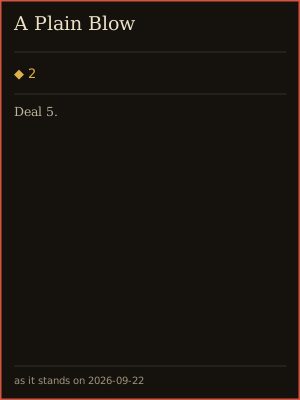
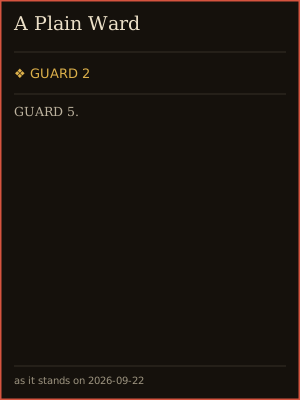
A fresh run now opens with ten plain grey cards: seven Grey Strike and three Grey Ward. Any die, wild included, can power them, and they carry no stance. The first three card rewards you take are drawn uniformly at random. From the fourth onward, rewards lean toward the keywords already in your deck, so a build starts to pull in its own direction.
Why it changed
Phase 104. The starting deck used to pre-decide a build before the player had made a single choice. A colourless opening deck lets the first rewards set the direction, and the keyword pull then rewards the direction you chose.
The grey deck lost every fight against the King of Revenge. He is pinned at level 3, and his HIDE 3 turned the grey deck's 2 and 5 damage into 1 and 2. The fix leaves the grey cards as they were. Instead, HIDE is now capped by a foe's level (none at levels 1 to 3), and only HIDE ramps this way. The village map gained three single-lane gate nodes (Tide-Line, Salt Flats and Breakwater Steps), so every route fights a grave-larva, a float-eye and a chattering skull before the King. Measured over 60 runs per cell: after one random reward, a fresh grey deck beats the King 93% of the time. With no reward at all it is 0%.
Why it changed
The maintainer ruled no card buff and no handicap on how many rewards you get. A win with no reward taken should stay possible only through near-perfect play. The gates guarantee every player the rewards the opening was balanced around.
Summoners, and three more regions on their own ground
What changed
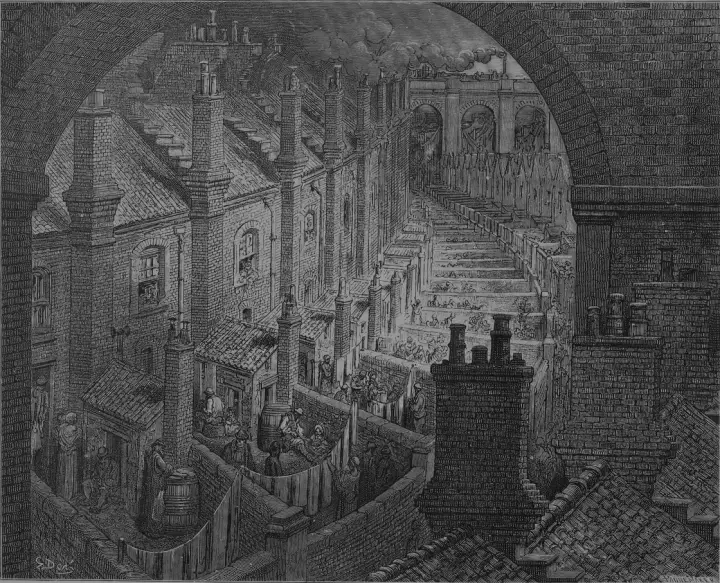
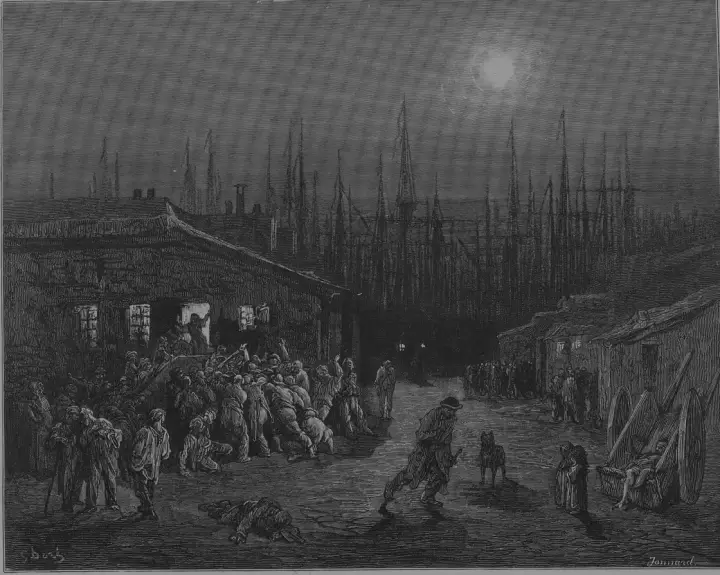
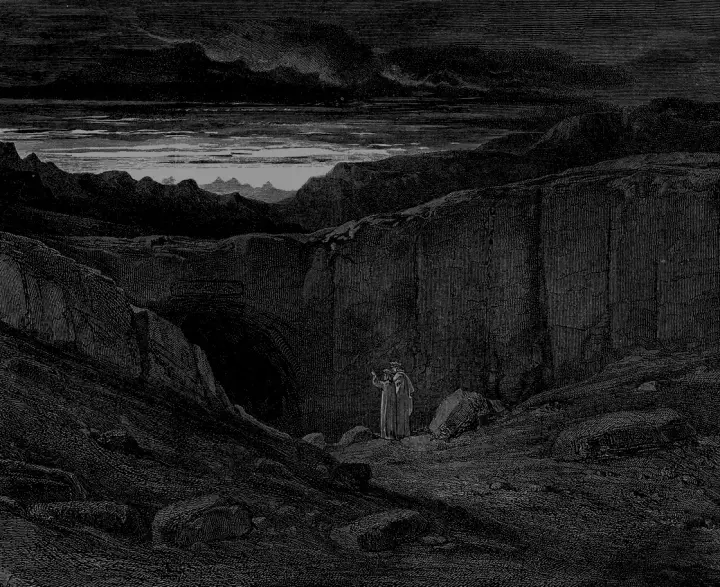
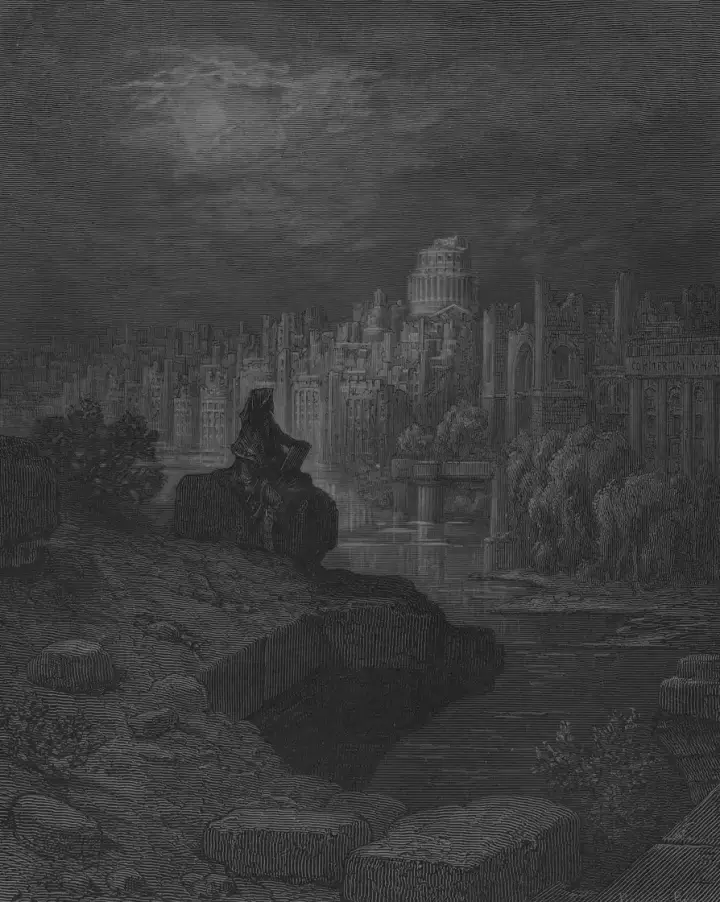
A new kind of foe fields bodies of its own. The first is The Jeweled Tree, with two Brier Shoots. Each body bites for a flat amount every threat phase. You clear one with a strike that costs Conviction but no die. Clearing the brood is progress, never victory: waves are capped at two and never respawn because you emptied the board. The telegraph had been showing DENIED ("no damage lands") on a staggered summoner while its brood still bit. It now prints the brood's share of the damage too. Separately, the Northern City, the Connecting River and the Sweetheart's Village now fight in front of their own Gustave Doré engravings, and so do The Caverns and The Capital. That brings bespoke arenas from 1 of 7 regions to 6 of 7. The fallback arena was a saturated pixel-art cityscape of untraced licence among nine wood engravings. It has been retired for Doré's "The New Zealander" (1873), the desolation plate below.
Why it changed
Phases 101 to 103. A fight in a borrowed city looked like every other fight. Summoning was the last enemy archetype still missing from the filed gaps (adjust-enemies). Retiring the fallback plate removed the most-seen art in the game whose right to be published could not be shown.
A returning player can return, and the map re-frames
What changed
Four bugs from a hands-on play session, all fixed:
Why it changed
Phases 97 to 100. The blank-screen bug hit 100% of returning players. The play-session report had reached the repository with no entry in any work queue, so no automated pass would ever have picked it up. Phase 99 closed that gap by hand, and the process hole was filed as its own finding.
Every player with a save got a permanent blank screen on launch. The
redirect into the map lost a race with the navigator and was never retried.
Progress between checkpoints was not saved.
The map camera framed once and never again, leaving 19 of 25 nodes
off-screen at the Crossing.
The map legend's counter disagreed with the chart.
Separately, the hand of cards no longer covers its own card names on a phone (it had read "THIN HYM / CHILBLAI / THE LONG"). A guard for the crash class behind the reported card-reward crash now runs on every change.
Eleven independent readers and skeptics went over the two large merges of 2026-09-19. They refuted 32 of about 110 claims the work made about itself, five at high severity. The high ones:
Why it changed
The work had been verified by the same session that wrote it. The audit was deliberately handed to readers who did not share its blind spots, and the fixes to a session that had not written the original.
Reloading on an encounter node skipped the fight.
The summoner's damage forecast omitted a divisor the engine applies.
Three "no damage" readouts still lied.
The combat log dropped every brood event.
The plate cropper returned the whole page when it found nothing.
The next day, a fresh session fixed all fourteen items in order (audit 3.1 to 3.14).
The first attended outlining session opened a new story overview, built one event at a time, with the maintainer choosing each. X begins drunk, guarding a prisoner in a castle dungeon. Events 2 to 6 follow the child, the mother at the gate and the lie, and a stretch where things are, for a while, okay. After event 5 the session recommended a pivot. Every event so far leans on one unresolved question (what X did in the cell), and it named four questions a higher-level session should settle first.
Why it changed
THE BLANK PAGE (2026-09-18) cleared all story law. This is the agreed way to rebuild it: from nothing, event by event, with the maintainer present. The start in a dungeon departs from the shipped fishing-village opening, and that is recorded as a note for the pivot rather than acted on.
Stewards: death lines for 32 foes, two potions split, FORGE given carriers
What changed
Three of the content stewards shipped real changes this window.
Why it changed
A foe with no closing line ends a fight in silence. Two identical potions at different rarities make one of them a trap. FORGE had been left without a single card since its theme was retired in August, so a player could never meet it.
The enemy steward wrote closing lines ("final blow" and "cause") for the 31
foes that had none, plus the pact lines TriEyes was missing. That closes a backlog filed on 2026-09-05 and re-cited, unacted, through fourteen passes.
The equipment steward split two potions that were byte-for-byte copies of
another. Body Elixir now grants the lesser Stoic Resolve, and War-Horn Draught a stronger Haste Surge.
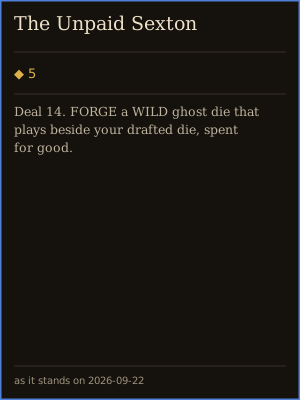
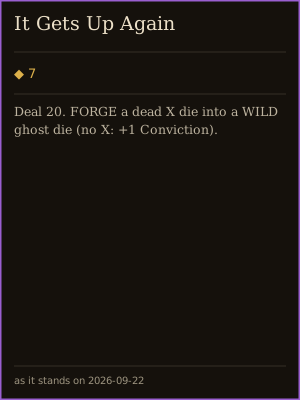
The keyword steward found that FORGE, a fully wired verb, had no card
printing it, and wrote two grave cards that do: The Unpaid Sexton and It Gets Up Again.
The development log, its before/after evidence and the full card and foe catalog are now built into a public site, and as of today it is deployed: https://axiomancer-devlog.pages.dev. The site's own live check passed on the first deploy: the landing page, the newest post, the catalog and the feed all serve. Separately, the Android build upload was cut roughly in half by leaving documents, plans and art sources out of it.
Why it changed
On 2026-09-20 the maintainer reversed the old "never meant to be public" policy, knowing it costs spoilers. Every post now holds back only the maintainer's private correspondence panel, plus any art whose right to be redistributed cannot be proven.
Did the fighting change? Re-measured at today's tip
What changed
The standing measurement was 7 engine commits behind (PR #353 moved card text and map traversal). It was re-run tonight at bc60858 with the reduced nightly pass (30 runs per cell).
Why it changed
PR #353 changed what cards display and how you walk the map, not how a fight resolves, and the measurement agrees: every stage is within noise of the previous full measurement. This reduced pass is directional, not confirmation-grade.
hand-fan names, crash guard, blank screen, map camera, three arenas, summoners, two more arenas
09-19 – 09-20
burn-day audit and its fourteen fixes
all fourteen landed
09-20
public DevLog build; phase 104 (grey deck)
shipped
09-21
early HIDE ramp; the three gates; baseline re-measured
shipped
09-21 – 09-22
critique passes 45, 46, 47
no findings
09-21 – 09-22
PR #353 (the nine-problem overhaul) and PR #354 (smaller Android upload)
merged
09-22
public DevLog project created and first deploy verified
live
09-22
nightly browser breadth leg (six suites, ten combat rounds)
all pass
The breadth leg passed. In this cloud container it needed its browser path set by hand, because the installed Playwright expected a newer headless shell than the image carries.
What is still unfinished
Quest rewards from NPCs and quest turn-ins do not yet give items. For now,
the only item you are handed through the new reward screen is the Suppliant's Ring at the start.
The opening fights of the fishing village are balanced around taking at
least one card reward. Skipping every reward and fighting the King of Revenge with the bare grey deck is meant to be near impossible.
The story is being rebuilt from nothing. The dialogue in the game today is
older text that stays until the new outline replaces it.
The measure — did the fighting change?
None. The loop's gates behaved this window: 41 of 41 ticks were green, three critique passes found nothing, and the one flaky browser run was re-run once and passed.
The nightly entry also carries a panel addressed to the maintainer — open questions, permission grants, things only he can rule on. It is held back from this page: it is correspondence, not a report. The unfinished work it tracks is published above, in plain words.