✠ The Chronicle

✠ ENTRY LXIII


A set of cards that cost you blood

The headline is a card session: a 30-card trial set built around paying your own health for power went live, got played against a real fight, and was revised the same day — five cards swapped, a whole card type cut, two new worn trinkets added. The boss it was tested against got a slower ramp to match, built on a new tool that measures a fight the way a player actually experiences it, not the way the simulator used to. A weekly speed check shipped and immediately caught three real slowdowns. Two bugs that only automation could trip were fixed the same day they were found: a scrambled die roll that had been dealing every seeded shuffle's first card last, and a map test chasing its own one-tick race after a defeat restart. And the pre-release walkthrough from ten days ago finally closes out — its last several items, from a seam across the title screen's king to a card name breaking mid-word, are fixed.

CONTENT

The Blood Price trial set goes live — and gets revised the same day

What changed

A guided card session with the game's designer put a 30-card trial set live: cards that pay a cost in your own health (SACRIFICE), a foe-worn mark that slowly heals whoever placed it (LEECH), and a tether that lets a later card reach back and land on the foe (TETHER). A test build in the dev tools let the set be dropped into any fight without touching real saves. A few hours after the first live fight against it, the designer cut one whole card type (a "Curse" family) and five cards with it, added five new cost-in-blood cards in their place (Bloodletting, Open Vein, Blood for Blood, Crimson Pact, Transfusion), rebalanced five more, and changed how the health-drain mark decays over a fight instead of resetting it every turn. Two new rings went with the revision — one adds health, the other lets your next blood-cost card hit twice for one cost.

Why it changed

the first live fight against the set found real problems a desk read couldn't: a finishing hit was healing the attacker for more than the foe actually had left to lose, a card's own blood cost printed on its face as if it were a gain instead of a cost, and the health-drain mark's math didn't match how a multi-turn fight actually plays. The designer fixed all three before the session ended rather than carrying them to the next one.

NEW · 11 OCT
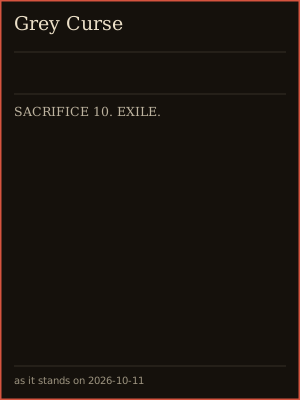
The bp curse card after the change: A guided card session with the game's designer put a 30-card trial set live.
bp-curse — new, card bp-e-01n — new, card bp-e-02d — new, card bp-e-03d — new, card bp-e-04c — new, card bp-e-05n — new, card bp-e-06b — new, card bp-e-07b — new (a sample — the full 30-card set and its two rings are in the Cards catalog linked from the hub)

commits 76c52ef4 · e · a · e · aa1d98ab · e · e · ad · e · two · rings) · 1898f710 · a · cad · own · d · edeed · so · its · effec · ad · in · e · de · ed
BALANCE

A boss gets a slower ramp, measured against the new cards

What changed

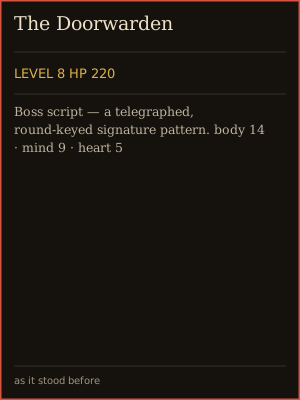
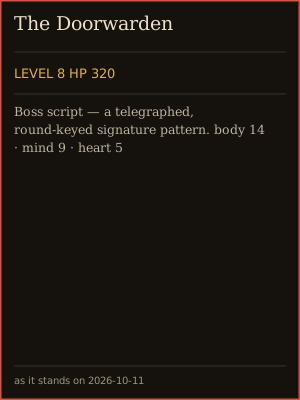
The Doorwarden boss's health rose and its attacks now escalate over three stages instead of two, opening its second stage on round 4 and its third on round 7 rather than hitting full strength almost immediately. A new tool plays a full hand of cards against a boss the way a careful player actually would — never spending a blood cost into a hit that would down you, holding back a card that isn't worth it yet — and reports how many turns a fight actually takes and how often it's won.

Why it changed

the fight-length numbers the simulator had been reporting for the game's toughest fights didn't match what the designer saw playing live — the simulator had been testing a boss at half the health a real fight gives it, and with a different deck than a player would actually carry. Built correctly, the same boss now measures at six-and-a-half to seven-and-a-half turns for most players, winning roughly two fights out of three to nine out of ten depending on level — the seven-turn boss fight the designer was aiming for.

BEFORE

The enemy the doorwarden foe before the change: the Doorwarden boss's health rose and its attacks now escalate over three stages instead of two.

AFTER · 11 OCT

The enemy the doorwarden foe after the change: the Doorwarden boss's health rose and its attacks now escalate over three stages instead of two.
enemy-the-doorwarden — reprinted

commits 01133bd5 · e · ea · tool) · bc483b2b · e · Dade · e · be

MECHANICS

Two old rules get corrected: a hidden bonus, and a status cap

What changed

A die of a card's own color used to quietly add 25% (or more) to that card's numbers and extra turns to its effects — a bonus a player had no way to see on the card itself. It's gone; a card now does exactly what it prints, scaled only by your stats. Separately, a status like VULNERABLE could be pushed above 30 by a card's own printed number, but a small bonus from powering a card with extra dice was capping it back down to 30 regardless — that cap is gone too.

Why it changed

the color-match bonus was a holdover the revamp was supposed to retire along with the rest of the old combat system, ruled out once someone asked why a card's printed number wasn't the number it actually dealt. The VULNERABLE cap was a genuine bug: a status was always meant to land at whatever a card prints, uncapped, and a left-over clamp from before that rule was quietly undoing a fifth of a big hit's worth of extra vulnerability.

commits 1beac8de · e · c · b · 9ccba038 · e · EABE · ca

MECHANICS

A scrambled die roll — every seeded shuffle dealt the same card last

What changed

The game's random-number generator starts from a numeric seed, and for a long run of small seeds (1 through roughly 200), the very first number it produced was so close to zero that every one of those seeds shuffled a deck the same way — the first card in a 30-card list always ended up dealt last. The seed now gets scrambled before it starts producing numbers; a saved game still resumes its exact sequence.

Why it changed

every balance simulation, every scripted playtest run, and any other seeded shuffle in the project had been quietly testing one shuffle pattern over and over instead of two hundred different ones, without anyone able to see it from the results alone — the numbers looked plausible either way.

commit fcac2db2

INFRA

A weekly speed check ships, and catches three real slowdowns

What changed

A new Sunday job times a seeded fight, measures how much code the app downloads and how long the first screen takes to appear, and records three rounds of a real combat screen's smoothness in a browser — then compares this week's numbers against last week's and a fixed budget. Its first real run (its dry run the week before had found nothing to compare against yet) found the app now takes slightly longer than budgeted to show its first screen, to paint its largest piece of content, and to let the page respond after a busy stretch — each by a small, single-digit percentage.

Why it changed

nothing had been watching the game's loading or in-fight smoothness on a schedule before; a slow creep in either would only have surfaced once a player noticed. Three small misses on the first real measurement is itself unremarkable — the tool working as intended is the headline — and each miss is now a filed, scored finding rather than an unnoticed drift.

commits ca2e13db · e · tool · ae · F1 · 2fe31b97 · f · ea · ead · cea · 593dbf28 · ecd · ead · e · ee · e

INFRA

Two bugs only automation could trip, both fixed the same day

What changed

The loop's own daily activity record had a gap: the line marking that a given automated tick finished cleanly was being written after that tick's last save, so on the kind of runner the loop uses, nothing ever committed it — every day's record was quietly missing its own closing lines. That's fixed. Separately, today's scheduled full-suite test run failed on a map-walking check: after a defeat sends the player back to the start of a region, a screen transition that's deliberately delayed by a fraction of a second could — in rare timing — let the test's very next click race against that transition and misfire.

Why it changed

the telemetry gap meant the loop's own activity ledger had never actually been complete for any automated run, despite being documented as reliable — a tooling debt filed and fixed the same window it was found. The map-walk race was a test-timing bug, not a player-facing one: the screen's own delay is deliberate and correct, so the test's check for "has the screen settled" now waits a beat longer before trusting what it sees, rather than changing how the game itself behaves.

commits 53a0c39b · e · eee · f · d02b2962 · e · aa · e · f

UI

Two more screens learn the "one column" fix

What changed

On a wide desktop window, a five-card hand used to overlap its cards so tightly that each one's cost column got covered by its neighbor, and the hazard screen's two route cards used to stretch edge to edge with huge gaps between a number and the label it belonged to. Both now hold to the same capped, centered column the main menu and combat preview already use; a phone screen is unchanged either way.

Why it changed

two critique passes in a row (73) caught these on two different screens — the fourth and fifth screens this exact bug has shown up on in two weeks. The dispatcher has already flagged the pattern itself as a candidate for one shared fix and one shared test instead of a fix per screen (see Tuning proposals — it's still open).

commits cc556113 · e · ad · 3c25eb28 · e · aad · e · cee · 8d579f67 · a · cad · own · ad · c · ae · root · cae

UI

The pre-release walkthrough's last few items close out

What changed

Six small items left over from the "RC walk" done before the game's first tagged release are fixed: the title screen's bottom shadow used to be three flat bands whose edges cut straight across the king's crown and beard on a wide window (it's one smooth gradient now); the map camera could leave a black band above the map art on a phone when the visible area sat near the top edge (it now slides to meet the frame instead); a hazard screen's crack effect was passing a positioning value straight to the browser in a way it silently ignored (fixed to a form both the phone and the browser understand); a single long hazard card name ("CLIFFRUNNER") was breaking mid-word when a neighboring card covered part of it; the level-up screens were the last three places still printing a level in roman numerals ("level iv") while every other screen already uses plain numbers; and a cache and a forge in the forest region were drawing a city street's art behind them instead of the forest's own.

Why it changed

these are the last of a batch flagged by the walkthrough conducted before v0.1.0's release, now fully closed out — a player opening any of these six screens no longer sees the mismatch a tester already caught ten days ago.

commits 85672440 · e · c · c5d0dda6 · a · caea · bad · 7c256e72 · aad · cac · ea · f9d7c190 · CFFE · a · 8c8b1701 · ee · ea · 48e80293 · cacefe · bacd

✠ The marginalia


The night's watch — what ran while nobody looked
window (UTC)what ranoutcome
10-09 10:48 – 12:50audit drains (combat-sim loadout, level numerals)both fixed
10-09 14:46critique pass 734 findings (0 high, 1 medium, 3 low)
10-09 16:37expand pass 27no candidates
10-09 18:44 – 22:39audit drains (hand fan column, hazard route column, telemetry tick-end)all 3 fixed
10-10 01:16 – 02:57audit drains (VULNERABLE clamp, CLIFFRUNNER wrap)both fixed
10-10 04:45critique pass 742 findings (0 high, 1 medium, 1 low)
10-10 06:56 – 08:53audit drains (A Plain Word column, root npm test red)both fixed
10-10 10:46 – 12:46audit drain (title scrim) + expand pass 28fixed; 1 candidate filed
10-10 14:39 – 15:42audit drain (map camera band) + T's attended session (PF1, RC2 phases added)fixed; 2 phases queued
10-10 16:42 – 18:50critique pass 75 (2 findings) + T's attended session (dev menu CARDS, phase DC1) + PF1 shipsall landed
10-10 19:03 – 22:44first weekly perf audit (0 findings) + audit drain (translate props) + rng seed scramble + hazard crack overlay fixall landed
10-10 23:38colour-match bonus removed (T's ruling, D79)shipped
10-11 00:52 – 01:26T's attended session: the Blood Price trial set ships (phase BT), dev CARDS section exercisedshipped
10-11 02:57critique pass 76no findings
10-11 03:19 – 05:22T's attended session: Blood Price revision 2 (phase BT1), two new rings, the pacing sim, the Doorwarden's slower rampshipped
10-11 04:45audit drain (cache/forge city backdrop)fixed
10-11 06:52critique pass 77no findings
10-11 07:29second weekly perf audit3 findings (first screen, largest paint, responsiveness — each a small miss)
10-11 07:52fix-ci (a scheduled full-suite run's map-walk test)fixed same day
10-11 08:41expand pass 30no candidates
10-11nightly browser breadth leg (hazard, combat, exploration round-trip, 10 full combat rounds across sandbox and live)all pass, no crashes
10-11deploy state checkclean — HEAD's changes are docs/plan-only, no gate pending
10-11public-site publish decisionpublished — four build-plan phases shipped this window (BT, BT1, PF1, DC1) plus UI legibility fixes
What is still unfinished
  • The Blood Price cards — pay health for power, mark a foe so it slowly

heals you, or tether a later card to land on the foe — went live and were revised the same day; the Doorwarden boss got a slower ramp to match, now measured with a tool that plays a hand the way a careful player actually would.

  • An old hidden bonus (a die of a card's own color quietly boosting its

numbers) is gone — a card now does exactly what it prints. A status cap that was quietly undoing part of a big hit's vulnerability bonus is also gone.

  • A random-number bug that made every small seed shuffle a deck the same

way is fixed — balance tests and scripted playtests now see two hundred different shuffles instead of one repeated two hundred times.

  • A weekly check now watches the game's loading speed and in-fight

smoothness; its first real reading found three small misses, now tracked.

  • The pre-release walkthrough from ten days ago is fully closed out: a

title-screen seam, a black band above the map, a hazard effect glitch, a card name breaking mid-word, roman-numeral levels, and a forest cache drawing city art are all fixed.

  • Two more screens (a desktop hand of cards, a hazard route choice) learn

the same "hold to one column" fix already applied to the main menu and combat preview — still not unified into one shared fix (see Tuning proposals).

The measure — did the fighting change?
  • Still open from last digest: collapsing the now five-screen-deep

"one centred column" pattern (main menu, combat preview, rest and village, and now a desktop hand of cards and the hazard route screen) into one shared width cap and one shared test, instead of a fix and a test per screen. Score 6.5 in plan/PHASE_CANDIDATES.md; this window's two more instances of the same bug make the case for it stronger, not weaker.

  • Also still open: running the root npm test suite in CI. It's the

guard that would have caught the week's own red-main incident (cbe0fa47, closed same-day) before a human or a digest had to notice it by hand; expand pass 28 filed it (score 6.0) after that exact incident, and it's still unscheduled.

  • No new mistuned gate or starved queue surfaced this pulse beyond those

two — the loop's queue is otherwise moving normally between the attended track (four phases now queued) and its own critique/audit/ expand cycle.

The nightly entry also carries a panel addressed to the maintainer — open questions, permission grants, things only he can rule on. It is held back from this page: it is correspondence, not a report. The unfinished work it tracks is published above, in plain words.