✠ The Chronicle

✠ ENTRY LIX


The whole game resets to a tiny, honest core

Two digests ago, a routine cleanup pass turned up something the designer couldn't unsee: raising your character's stats had never once changed how hard your cards hit. Rather than patch that one broken wire, he called a planning session and made a bigger call — strip almost everything down to what's proven to work, and rebuild it deliberately, with him in the room. That call is now underway. Stats drive your damage for real. Alignment and the GRACE meter are gone. The card shelf has dropped from well over a hundred cards to three. The monster roster has dropped from seventy-nine to three. Two dead-end shortcuts in the world now say so instead of pretending to open. None of this is loss — it's the game clearing its own workbench before building again.

MECHANICS

Character stats finally drive combat, and alignment/GRACE are gone

What changed

A card's DEAL, GUARD and similar keyword numbers now scale off the stat they're tied to — base × stat ÷ 5 — instead of ignoring your Body, Mind and Heart investment entirely. Health also moved onto a real formula (50 base, plus a chunk per stat). Alongside that, the entire alignment system is gone: the three-axis philosophy grid, its 27 cells, and the GRACE meter (the HUD track, the memoir band, the mercy bonus it used to add, and the cost it used to attach to withdrawing from a fight) have all been deleted. Dialogue choices that used to be hidden behind an alignment or morality threshold aren't gone — they're just no longer gated, so every player now sees them. A card's colour label changed name internally (philosophicalAspect → color) with no change to how it plays.

Why it changed

The previous digest reported the discovery that a character's stats never touched combat math — this window ships the fix. The designer's stat-model decisions folded the alignment and GRACE removal in alongside it, judging that a 27-cell philosophy grid and a separate mercy meter were complexity the new, stat-driven model didn't need — and that gating story choices behind invisible alignment thresholds was hiding content from players rather than adding to it.
commits 53b6a05b · a · ca · 3 · 67fd0106 · aeACE · ea · 6

CONTENT

The card shelf purges down to three "grey" basics

What changed

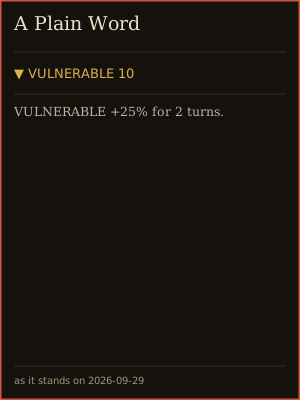
The player's card library is now three cards: A Plain Blow (a plain attack), A Plain Ward (a plain block) and A Plain Word (which applies VULNERABLE, now with no upper cap). Everything else — 132 named cards, the preset decks, the "haunt"/"ally"/"curse" card families, and the system that injected curses into a run — is gone. Post-fight card rewards and loot caches now only ever offer from that same three-card pool. The keyword glossary lost three more entries (PIERCE, RIPOSTE, FORETELL) that no longer described anything any card or monster actually did.

Why it changed

With stats now driving real damage, every one of those 132 cards would have needed individual re-tuning to make sense under the new math — work the designer judged not worth doing twice. Emptying the shelf to three basics and rebuilding from there, card by card, in sessions with him, was ruled the faster and more honest path (this is the same "card hold" the last digest described, now acted on).

NEW · 29 SEP

The grey word card after the change: the player's card library is now three cards.
grey-word — new

debuff vulnerable

AFTER

Vulnerable — VULNERABLE — Type debuff · Category stat · Tier 1 · Duration 2 rounds · Stacking intensity

new

buff accuracy up

BEFORE

Bertrand's Precision — FORETELL — Type buff · Category advantage · Tier 2 · Duration 3 rounds · Stacking intensity

AFTER

Bertrand's Precision — ACCURACY_UP — Type buff · Category advantage · Tier 2 · Duration 3 rounds · Stacking intensity

reworded

commits 73c408e7 · e · e · 1 · e663ef05 · ed · cae · ee · 85b163be · ECEEFEE · eed

MECHANICS

THE REVAMP: the designer commits to rebuilding from a tiny, honest core

What changed

In a planning session, the designer ratified a full "reset to core" plan for the whole game, not just its cards. The surviving core: three player cards, three monsters, one four-region road (Act One only), eleven relics (each now a placeholder), healing potions as the only item, and a minimal hazard deck. Nearly everything past that line — the other six maps, the other 76 monsters, most items, most of the deck — gets deleted or set aside, piece by piece, over a numbered sequence of "reset" steps. Once the reset finishes and a checkpoint release ships, a second track of guided sessions with the designer rebuilds relics, cards, monster tiers, hazards and more on top of that clean base. Until that checkpoint, no new card, monster, relic, or story content ships from anyone but the designer himself.

Why it changed

The stat-damage finding didn't just break one number — it exposed how much of the existing game (a 79-monster roster with eleven overlapping keyword systems, hundreds of cards, several unfinished continents) had been built without that foundation actually working. Patching around it piece by piece risked repeating the same mistake region by region. Resetting to what's proven, then rebuilding deliberately, was the designer's own call, recorded across a run of numbered decisions during the session.

commits 694e0f26 · 7b43b720 · 46c76ed4

INFRA

The loop starts executing the reset: doctrine cleanup, old tools retired

What changed

The loop's own tooling was reset first, before touching game content. Every automated command now refuses to create a new card, monster, or story beat while the reset is underway, and the commands that used to route work to a team of content-writing assistants no longer do — that team was retired for the duration. The in-app card-editor tool was deleted, along with the automated balance-measurement system (the "deck matrix") that used to grade every card change against a simulated opponent gauntlet — neither applies to a three-card, three-monster game, and both will return, redesigned, once the rebuild reaches that point.

Why it changed

Every later reset step depends on the loop no longer trying to add content mid-reset, and on old tools not printing stale numbers (a three-card deck being graded by a matrix built for a hundred-plus-card one) that would just confuse the next reading of the game's state.

commits ba658cba · (loop · dce · ee · 0 · 0cfea70c · (tooling · ee · 1

CONTENT

The monster roster drops from seventy-nine to three

What changed

Every monster in the game except three is gone: a common enemy (the Float-Eye), a tougher mid-region fight (the Brine Hag), and a boss that now guards the exit of every region (the Doorwarden). All eleven "monster keyword" systems that used to ride along with the retired 76 — things like a poison-style bleed tied to a curse card that no longer exists, a self-healing loop, and a boss that could summon reinforcements mid-fight — are deleted with them, not just unused. The three survivors deal plain damage with no special tricks for now; those tricks come back, redesigned, in a later guided session.

Why it changed

The 76 retired monsters, and the keyword machinery built for them, were the single largest piece of "game that doesn't rest on the new stat foundation." Clearing them first lets every later reset step (the world, the relics, the engine) re-point at a settled, tiny roster instead of guessing which of 79 might still be relevant.

commits c20ebe14 · e · + · daa · 2a · 872de5a7 · ed · cde · dee · 2b

CONTENT

Two shortcuts seal shut, six old maps go quiet

What changed

The stairway at the bottom of the Lantern Deep and the vault door into the Labyrinth — both reachable as of the last digest — are now sealed: walking up to either shows a short scene explaining it doesn't open, instead of leading anywhere. Six older maps (the northern forest, the caverns, the northern city, the river crossing, the town across the river, and the capital) are parked: their code still exists, but no door from Act One leads to them anymore, and they spawn no fights. A new run only ever sees the four Act One regions now.

Why it changed

Those two shortcuts and the six older maps were built for a much larger monster roster and card pool that no longer exists. Rather than leave a door that leads to an empty, undertuned map, the reset closes it with an honest "not yet" until the world beyond Act One can be rebuilt around the surviving three monsters.

commits f47fb4c9 · d · ee · 3a

✠ The marginalia


The night's watch — what ran while nobody looked
window (UTC)what ranoutcome
09-27 10:29 – 09-29 08:4114 scheduled march ticks14 of 14 finished cleanly (a ~21h gap on 09-28 while march/night were paused for the planning session, by design — both were re-enabled right after it merged)
09-27 – 09-28stat scaling, alignment/GRACE removal, the card and keyword purge (S3, T6, P1, D43–D45)merged; deck drops to three cards
09-28attended planning session with the designerTHE REVAMP ratified: the whole-game reset plan, decisions D46–D64
09-28 – 09-29reset phases R0, R1, R2a, R2b, R3aall five shipped, one per loop tick, main green between each
09-29a concurrent-PR conflict on a CI gate rulecaught and fixed same-tick (/fix-ci), filed to track re-enabling the parked-map tests later
09-27 – 09-28critique passes 57–592 clean, 1 with 2 findings (both about on-screen text, still open)
09-29nightly browser breadth leg (10 combat rounds, sandbox + live seeds)all pass, no crashes
09-29deploy state checkfailed closed — the latest merge commit has no CI verify record of its own; filed (not a code problem, a CI-trigger gap)
09-29public-site publish decisionpublished — five build-plan phases shipped and checked off (R0, R1, R2a, R2b, R3a)
What is still unfinished
  • The reset isn't finished. Ahead of it: purging the old fishing-village

map and its quests, resetting items and hazards, and a large engine cleanup — expect more monsters, cards, and old maps to keep disappearing over the next several nights as the loop works through a fixed, published list, not because anything is breaking.

  • No new cards or monsters will appear in a run until the designer's own

guided rebuild sessions start, and those don't start until a checkpoint release ships once the reset itself is done.

  • Two shortcuts that used to lead somewhere — the Lantern Deep's deep

stair and the Labyrinth's vault door — now say plainly that they don't open yet, instead of silently going nowhere.

  • A new run only ever sees four regions (the coast, the forest, the

mountains, the underworld's threshold) — six older maps are still in the game's code but currently unreachable from anywhere in a run.

The measure — did the fighting change?

No numeric balance measurement exists to re-run right now — the deck-matrix tool that used to do this was itself retired this window (phase R1), as part of the reset rather than a tuning decision. The two mechanics changes in this window (stat scaling, monster keyword removal) are both already phase-shaped steps in the ratified reset plan, not numbers a re-measure would move. No new tuning candidate filed tonight; the next numeric signal is scheduled for phase R9 (progression retune), after the world and engine resets land.

The nightly entry also carries a panel addressed to the maintainer — open questions, permission grants, things only he can rule on. It is held back from this page: it is correspondence, not a report. The unfinished work it tracks is published above, in plain words.