✠ The Chronicle

✠ ENTRY LVIII


Act One becomes four real places to walk

Where the game used to start you in a fishing village with no memory of how you got there, a new run now opens on a windswept coast, at a windmill above a breakwater — the first stop on a four-map road through a forest, a mountain range, and a candlelit underworld, each one drawn from its own hand-made engraving. A sealed vault door at the bottom of that road now actually leads somewhere. Underneath all of it, a five-part clean-out of the game's engine turned up a hard truth: raising your character's stats has never done anything in a fight. And for now, that finding pauses new cards — the designer wants to purge the deck down to two starter cards and rebuild it with stats that actually matter, in a session with him, not the loop working alone.

MECHANICS

Act One becomes four real places to walk

What changed

A new game now starts on the coast, at a windmill overlooking a stretch of shoreline called The Breakwater — not in the fishing village that used to open every run. From there, the road runs coast → The Charcoal Wood → The Beacon Crags → The Lantern Deep, four brand-new maps, each built from its own square engraving (coast, forest, mountain fastness, candlelit underworld) instead of the placeholder art the old maps used. Each map now has its own canvas sized to its art, so the map can spread up, down, left, and right from wherever you enter it, rather than only climbing in one direction. Every landmark drawn on each engraving got its own node to stand on. Each region carries one elite fight — the toughest battle before its exit — and the last one, the Lantern Deep, ends at a sealed vault door that finally leads into the Aporia, the Labyrinth's underworld, instead of only being reachable through a developer menu. The old seven maps (fishing village, northern forest, the caverns, and onward) aren't gone — they're still fully playable, just waiting their turn to be folded into a later chapter of the story. Combat's background art is intentionally plain black for now on every map, old and new alike, until Act One gets its own painted arenas.

Why it changed

The maps a new player actually walks were placeholders — grids you climbed one column at a time, textureless, disconnected from the world's atmosphere. The game's designer generated four proper engravings, one per Act One region, and ruled (in a series of decisions recorded 2026-09-25/26) that the new run should open on them immediately rather than waiting for every later chapter to be ready first. The road order (coast, forest, mountains, underworld last) and the Labyrinth door's placement — right on the vault-door landmark drawn into the underworld plate — are both the designer's direct calls, not loop inference. The elite-per-region shape gives each map a real capstone fight instead of ending on a soft whimper.

commits dd204684 · e2befb89 · 3a · e · Beaae · 1d6f39c0 · 3b · e · Caca · d · 18c6e107 · 3c · e · Beac · Ca · 4b8c32f3 · 3d · e · ae · Dee · 425525ce · 3e · fae · eed · to · f · Ac · e · 571d5b3f · 4 · e · ab · d · 1ec11390 · 5 · dc · — · PRs · 382397
INFRA

A five-part engine clean-out finds the character stats do nothing in a fight

What changed

A five-part audit and cleanup pass (nicknamed "Trim the Fat" internally) went through the combat engine, the mobile app, the docs, and the loop's own planning notes, and deleted a large pile of dead code: a legacy dice-rolling pipeline nobody used anymore, a shelved visual-effects system, eight unused tuning commands, and stale documentation describing systems that no longer exist. Along the way, the audit found something more consequential than any of the cleanup itself: the combat engine never actually reads a character's body, mind, or heart stat when calculating card damage. The only thing those stats currently affect is your maximum health. Raising a stat you chose to specialize in makes no combat difference at all.

Why it changed

That finding changes what comes next more than any of the cleanup does. Building a real connection between a character's stats and their card damage requires deciding, with the designer, exactly which stat should drive which kind of damage — not a call the loop can make on its own. Rather than keep shipping small card and keyword changes into a deck that's about to be rebuilt around that new stat hook, the designer ruled the loop should pause card and keyword creation entirely: once the stat hook ships, every player card gets purged except the two starting cards (a plain blow and a plain block), and the deck gets rebuilt from there with him in the room. Until then, no steward or loop verb creates a new player card or keyword.

commits e9f1735e · 1 · 2ef8f790 · 2a · d565910d · 2b · 8ef3c7da · 3 · bc6ea7d3 · 4 · e6c7fb75 · c2eb7f18 · 5 · — · PRs · 369381

UI

The character sheet's GRACE header stopped hiding under another panel

What changed

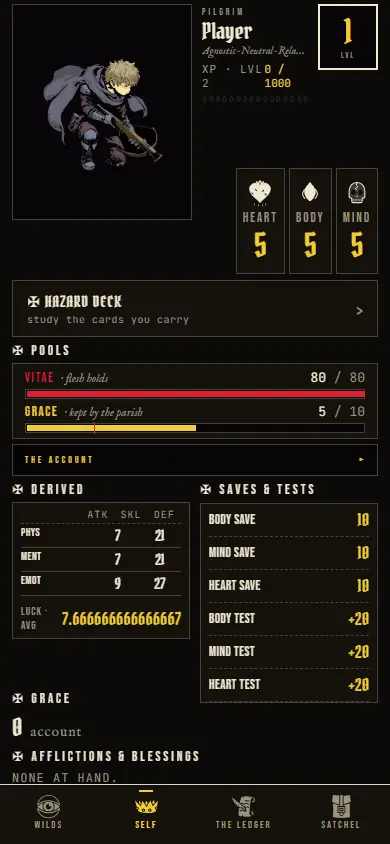
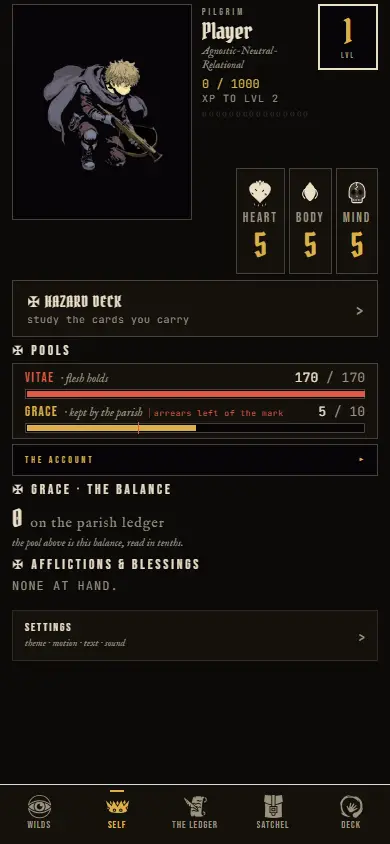
On the character screen, the GRACE section's heading was sliding up underneath the panel above it (labeled THE ACCOUNT), so the heading was partly obscured instead of sitting cleanly above its own section.

Why it changed

An earlier change removed a section that used to sit directly above GRACE, but a leftover negative top-margin on the GRACE heading — tuned to tuck neatly under that now-deleted section — stayed in place and pulled the heading up into whatever now sat above it instead. Dropping the stale margin lets GRACE sit where its own spacing says it should.

BEFORE · 25 SEP

The character screen before the change: on the character screen.

AFTER · 27 SEP

The character screen after the change: on the character screen.
character — the GRACE heading now clears THE ACCOUNT panel instead of sliding under it.

commit c0a1d264

CONTENT

The trim's cleanup ripples into cards, loot, and keyword text

What changed

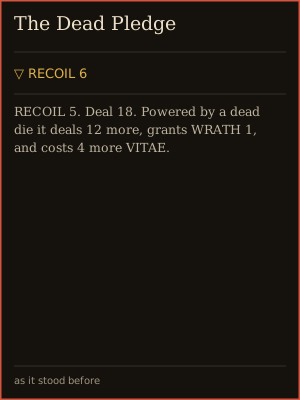
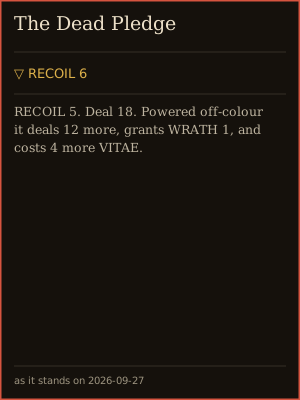
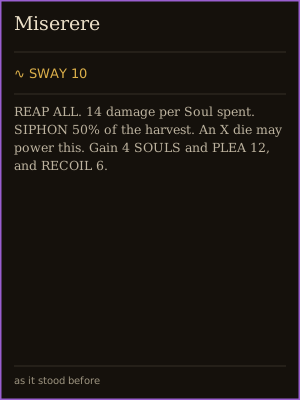
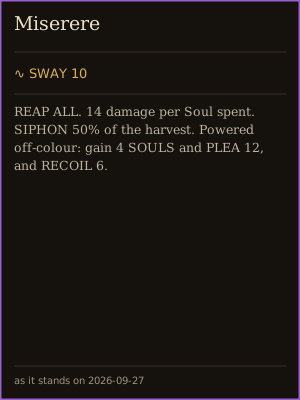
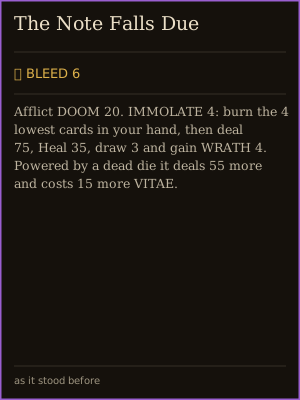
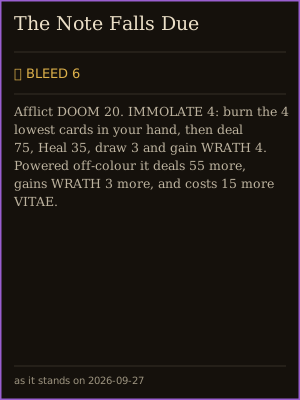
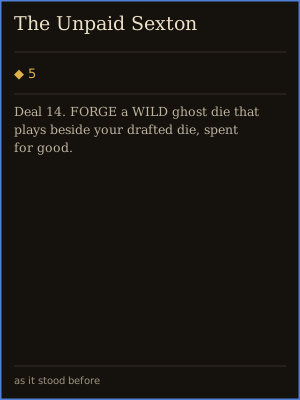
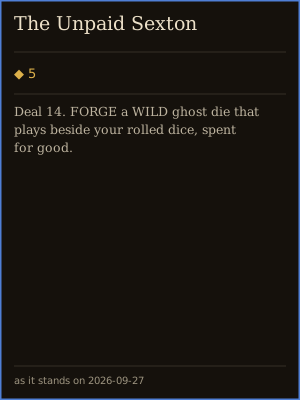
Three cards (Miserere, Dead Pledge, The Note Falls Due) had a die-roll bonus tied to a mechanic ("fate") that an earlier change already deleted, so the line printed on the card face never actually did anything — it's now a real, working bonus instead of dead text. A fourth card, The Unpaid Sexton, said "drafted die" on its face when the game no longer drafts dice, so its copy now says "rolled dice" instead. Loot caches also stopped offering roughly half of their consumable-item pool, after an earlier item-system cleanup made those items impossible to use — caches now only ever offer consumables that actually do something. The keyword glossary got a matching pass: several entries still described mechanics ("fate", a save bonus, a resist roll) that no longer exist in the shipped game.

Why it changed

All four threads trace back to the same cause — the trim cleanup deleted mechanics that some cards, item pools, and keyword text still assumed were live, leaving card faces, loot tables, and the glossary telling players about rules that no longer apply. A card whose printed text does nothing, or a loot pool that hands out dead weight half the time, erodes trust in what the game tells you before you commit to a play.

BEFORE

The dead pledge card before the change: three cards (*Miserere*.

AFTER · 27 SEP

The dead pledge card after the change: three cards (*Miserere*.
dead-pledge — reprinted

BEFORE

The miserere card before the change: three cards (*Miserere*.

AFTER · 27 SEP

The miserere card after the change: three cards (*Miserere*.
miserere — reprinted

BEFORE

The the note falls due card before the change: three cards (*Miserere*.

AFTER · 27 SEP

The the note falls due card after the change: three cards (*Miserere*.
the-note-falls-due — reprinted

BEFORE

The the unpaid sexton card before the change: three cards (*Miserere*.

AFTER · 27 SEP

The the unpaid sexton card after the change: three cards (*Miserere*.
the-unpaid-sexton — reprinted

commits 5d6eca56 · cad · ce99372a · (loot · cace · 27bd4d2d · ed · a

✠ The marginalia


The night's watch — what ran while nobody looked
window (UTC)what ranoutcome
09-25 09:22 – 09-27 08:4225 scheduled march ticks25 of 25 finished cleanly
09-25 – 09-26TRIM THE FAT, T1–T5 (PRs #369–#381)merged; decorative-stats finding recorded
09-25 – 09-26THE MAP REVAMP, M0–M5 (PRs #382–#397)merged; Act One walkable end to end
09-26attended session with the designerthe card hold (D36–D38): pause card/keyword creation, queue a full card purge after the stat hook ships
09-25 – 09-27critique passes 50–563 clean passes, 4 with a single finding each (mostly Act-One-related text needing to catch up to the new maps)
09-25 – 09-27/adjust-cards, -equipment (×2), -npcs (×2), -keywords, -enemiesone content fix each from cards/equipment/keywords; two content gaps filed (see Needs you)
09-25/expand pass 212 candidates filed (both about reconciling old story content with new rulings)
09-27nightly browser breadth leg (10 combat rounds, sandbox + live seeds)all pass, no crashes
09-27deck-matrix baseline freshness checkfresh at b5fb0ac9, full confidence — no re-measure needed
09-27deploy state checkclean — no gated workflow pending on HEAD
09-27public-site publish decisionpublished — a major release (four new Act One regions, checked off the build plan)
What is still unfinished
  • The card and keyword pools are frozen for now: no new cards or

keywords ship until an attended session settles how stats should drive card damage, after which most of today's cards get purged down to two starters and rebuilt from there.

  • Act One (the coast, the forest, the mountains, the underworld) has no

shop of its own yet — the nearest relic market is still five maps further down the older road.

  • Three of the four new Act One maps, plus the new start map, have no

named people on them yet.

  • A card's damage-per-turn number can still visually break across two

lines on the small hand-card face — the numbers underneath are correct, it just reads oddly for a moment.

  • plan/AUDIT.md carries 66 open findings; plan/CRITIQUE.md carries 25

open findings; the phase-candidate backlog holds 39 open rows.

The measure — did the fighting change?

The deck-matrix baseline stayed fresh throughout this window — no mechanics-source commit landed that would have moved a card's math or an enemy's numbers, so no re-measurement was needed. The map revamp and the Trim the Fat cleanup were both structural (maps, dead-code removal); the one behavioral engine finding (character stats not affecting card damage) is a phase-shaped decision already queued as build-plan row S3, not a numeric tune. No new tuning candidate filed tonight.

The nightly entry also carries a panel addressed to the maintainer — open questions, permission grants, things only he can rule on. It is held back from this page: it is correspondence, not a report. The unfinished work it tracks is published above, in plain words.