✠ The Chronicle

✠ ENTRY LXIX


Every enemy in the game begins to move

Enemies used to be one flat picture each, win or lose. Now they rest, flinch and lunge in time with the fight — starting with the Act 1 boss, who finally gets a real face instead of a blank placeholder, and a mid-game elite who traded four arms for a single wobbling body. Thirty cards in the Blood Price set got real names and real paintings, five new hazard cards that cost you something joined the puzzle workshop along with twenty puzzles built on them, and a die dropped low on a card on Android now actually lands. Most of the rest of tonight's work happened under the hood, tightening the project's own checks on itself.

MECHANICS

Every enemy now has motion

What changed

Enemies used to render as a single static picture no matter what happened in the fight. They now play a resting loop between turns, flinch when struck, and lunge on their own attack — timed off the exact same moment combat already uses to decide whether a blow landed, so the motion can never show something the fight didn't actually do. The work landed in stages that changed no pixel until the very last step, so nothing was ever shipped half-working.

Why it changed

a still portrait read the same whether an attack hit or missed; giving the enemy itself something to show closes that gap. T asked for the work in this exact order — build the engine first, wire it to a real turn, add the three states once it was visible, then generate art for enemies already in the game — so each step could be checked before the next one built on it.

commits 1008d3c7 · de279d08 · fa34a928 · 14fcefaa · 6c1e50bb
CONTENT

The Act 1 boss gets a face

What changed

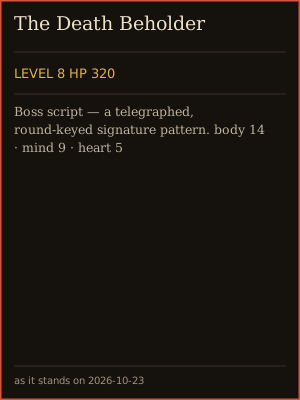
The boss at the end of Act 1 shipped as a flat white placeholder with two eye-shaped holes cut into it — a stand-in that had quietly become the act's actual climax. It's now a fully painted undead beholder, The Death Beholder, and it animates: it coils back and dims, then swells forward on the very next frame for its attack. The fight underneath is untouched — same level, same difficulty, same map placement, same loot — because a separate measurement phase depends on this fight staying exactly as it was.

Why it changed

the placeholder had been the real boss for longer than intended; this replaces the look without touching anything the game's own balance numbers are measured against.

NEW · 23 OCT

The enemy death beholder foe after the change: the boss at the end of Act 1 shipped as a flat white placeholder with two eye-shaped holes cut into it.
enemy-death-beholder — new

commits 5ac5fe2e · 3227fb9c

CONTENT

A reflection becomes a jelly

What changed

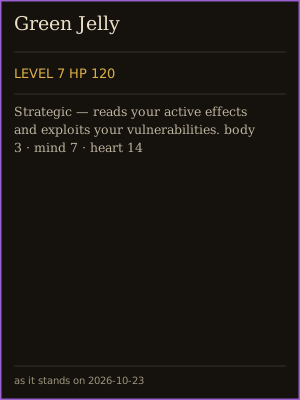
The mid-region elite, formerly "the Brine Hag," is now "The Green Jelly." T chose the new look after seeing it rigged for animation — a single translucent body that squashes at its base needed none of the four separate limb masks the Hag's arms did, and showed none of the seam they left. It now breathes at rest, flattens when struck, and squashes down before springing into its attack. The fight's level, loot, experience bonus and "make friends with it instead of fighting" option all carry over unchanged, including anyone who'd already befriended the Hag — their save quietly points at the Jelly now instead.

Why it changed

an art change made for animation, not for the fight itself; the save-compatibility work was necessary because, unlike the Act 1 boss, this enemy can be befriended, and that choice has to survive the rename.

NEW · 23 OCT

The enemy green jelly foe after the change: the mid-region elite.
enemy-green-jelly — new

commits 5117001a · bf677e86

MECHANICS

Combat loses a pop-up, and a flinch learns to wait

What changed

Two small fixes T caught watching the first preview build carrying the new animation work. The floating card that used to hover centered over the enemy for about two seconds after every round is gone — the existing threat icons, damage numbers and combat log already say what happened, so the card was saying it twice. And the enemy's "struck" flinch now waits for the player's own played card to finish moving across the board before it plays, instead of firing immediately and getting half-hidden behind it.

Why it changed

both were things T noticed getting in the way on a real build, not planned polish — the kind of thing that only shows up once the motion itself exists to watch.

commits 8b6b4c8b · 837c8c7c

CONTENT

Thirty Blood Price cards get names, and paintings

What changed

The last 25 placeholder-named cards in the Blood Price set ("Blood Price P-01a" and so on) now carry real names read off what each card actually does. All thirty cards in the set now carry a painting from an open-licence monster-art pack, with eleven re-picked afterward once the names were locked, to better match what each one is called.

Why it changed

naming and art were the last visible placeholders left on a set T had already approved mechanically; T approved the full name list and the painting set, then personally re-picked eleven to fit.

commits 818e44ed · 7726a573 · f54823f0

MECHANICS

Five hazard cards that cost you something, and twenty puzzles built on them

What changed

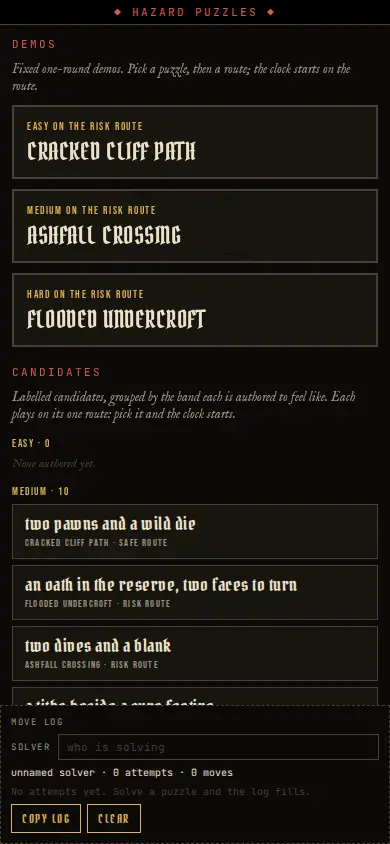
Five new cards for the hazard mini-game trade meter progress, or a die, for a benefit — a toll, a debt, an overdrive. T audited the first version and ruled that playing one of these unpowered must always have its own reason, not just be a worse version of playing it powered; their numbers were reworked so that holds everywhere. Twenty new puzzles (ten medium, ten hard) built on these cards replace the twenty easy/medium puzzles that didn't use them, and are now loaded onto the developer-only puzzle review board.

Why it changed

this is what the "T plays the thirty" demo (due 2026-11-02) is waiting on — with tonight's puzzles shipped, that demo's set is finally real and ready for T to play.

NEW · 23 OCT

The devpuzzle list screen after the change: five new cards for the hazard mini-game trade meter progress.
devpuzzle-list — the developer puzzle board, now listing the real ten-hard-plus-twenty-cost-card set (this is a developer-only screen, not reachable from a normal playthrough)

commits 0c7b101e · f2f361c5 · db6d4b8c · 41c97cb5 · fe5c3375

UI

A die dropped low on a card now lands, on Android

What changed

on Android, dropping a die onto the lower half of a staged card in either the hazard or combat board could silently miss. Android's edge-to-edge display shifts how the game was measuring a card's position by exactly one status bar's height, so the game and the drag disagreed about where the card actually was. Both boards now measure a drop the same way the drag itself is measured.

Why it changed

T found this on a real preview-build run; it affected hitting either board, not one screen.

commit ad05ae5a

INFRA

The merge gate learns five new ways to catch a broken pull request

What changed

the automatic check every change passes before it can merge now also: checks that the project's own planning files are shaped the way the tools expect; refuses to pass a change that touches a folder no automatic test is watching; requires that any pull request claiming a finished task point at a real, checkable test as proof, not just a ticked box; re-runs any newly added test against the code as it stood before the change, so a test that would have passed either way (and so proves nothing) gets flagged instead of counted as new coverage; and starts keeping score of how often the project's own AI playtesting pass actually catches the bugs it's shown.

Why it changed

each one closes a real gap the project had already hit — a queue file that got silently corrupted by a bad merge, a folder nothing was watching, a "done" checkbox with no evidence behind it, and tests that look like new coverage but aren't.

commits ef7aa0d8 · deff52b3 · 13eee0a4 · b8aa9f99 · 69b6753a

INFRA

The feature map starts mapping itself

What changed

a script now reads every screen and every engine area in the game and builds a map of how they connect — what leads to what, what's reachable, what's actually been played through by a real test, and what's missing a design brief — then renders it as both a browsable table and a visual diagram. Its first real run found five screens that are technically reachable but, right now, only through a developer shortcut, not a normal playthrough.

Why it changed

keeps the project's map of its own game honest without anyone having to redraw it by hand every time a screen is added, removed or rewired.

commits 47d0e494 · ddd6961a · e4714e41 · 13c4612c · 879d4d81

INFRA

Visual changes now carry their own before-and-after picture

What changed

whenever a change moves pixels on a screen, the project's own automated checks now take the before and after screenshots themselves and attach them to the change for review — so a difference can be seen, not just trusted. A second piece makes the version of this check that runs on a developer's own machine shoot only the screens a given change could plausibly affect, instead of every screen every time.

Why it changed

this project's visual check had gone stale before without anyone noticing — one screen's reference picture sat untouched for weeks — because nothing forced a look at the actual pixels before approving a change.

commits f7746930 · 69cebcca

INFRA

Art tools get their own home, sealed off from the shipped app

What changed

the Python tools that build enemy animation sheets, and the original master art files they work from, now live in a new top-level folder of their own, separate from the phone app's codebase. A new check makes sure nothing in that folder is ever pulled into the app or shipped in a build.

Why it changed

the tooling used to live inside the app's own folder even though it isn't code the app's checks can verify, and a folder of master art that must never ship needs an enforced boundary, not a trusted one — the project has already been burned once by a boundary nobody checked.

commits 4d37d3b4 · 58e81c3c

INFRA

Hazard-puzzle solve times move off the phone and onto a server

What changed

a small backend service now records every puzzle attempt a developer preview build makes — its layout, how it ended, how long it took — to a real database instead of just the one phone it happened on. A new report reads solve rate and solve time back out for every puzzle, grouped by how hard it's meant to be.

Why it changed

solve data used to live only on whichever phone ran it, with no way to compare puzzles against each other; this is what a later phase will use to set each puzzle's timer from real play instead of a guess.

commits 170b2906 · 8e64732f · 8113899e · 4dfe53c2

INFRA

Two small loop-housekeeping fixes

What changed

the project's own build automation stopped capping how many pull requests can merge in one day — a finished, reviewed change sometimes had to wait simply because twelve others had already landed that day, even though nothing about it was actually risky. Separately, when two planning sessions add new rows to the same plan file around the same time, a new merge rule now keeps both rows instead of silently dropping one, which used to need a person to notice and fix by hand.

Why it changed

the daily cap had never actually been written into the project's own rulebook, so it was enforcing a rule nobody had decided; the plan-file conflict had already bitten the project three times in two days before the fix landed.

commits 140064a2 · 34e8f9dd

✠ The marginalia


The night's watch — what ran while nobody looked
windowwhat ranoutcome
10-21 morningdispatcher ticksthe build-plan's own merge-conflict fix (ML1b, #705) merged right after the last digest closed; enemy animation (AN1), the solve-time backend (BE1) and the art-department split (AD1) were all plotted; the first animation and backend phases (AN1a, BE1a, AD1a) and a visual-CI step (VE1c) shipped
10-21 afternoondispatcher ticksthe daily pull-request cap was dropped (RV4); the backend went live on Cloudflare and started posting puzzle times (BE1b–d); the feature map's five phases (FM1a–e) all shipped, including the reachability drive that found five developer-only routes; the enemy's turn and its three animation states (AN1b, AN1c) shipped
10-21 evening–nightdispatcher ticksthe float-eye became the first enemy to actually move (AN1e); its sheet-generation art pipeline shipped (AN1d); the Android die-drop fix shipped; the "animation unobscured" phase (AN2) was plotted
10-22 overnight–morningdispatcher ticksthe hazard cost-card puzzles (HP5) and the Green Jelly's new identity (AN3) were plotted; the first merge-gate hardening (LG1a) shipped; the easy/medium puzzle candidates were dropped and the five cost cards shipped (HP5a, HP5c); the enemy action card was removed (AN2a); the Death Beholder was plotted (AN4); the long-standing card-creation hold was lifted (D99); the Jelly and Beholder art was ingested
10-22 daytimedispatcher ticksthe Death Beholder became the real Act 1 boss and started animating (AN4a, AN4b); a second merge-gate check shipped (LG1b); T's redesign of the five cost cards, costs rendered on the board, and the twenty new puzzles all shipped (HP5b, HP5d); the Green Jelly shipped and started animating (AN3a, AN3b); the Blood Price cards got real names, then real paintings, then eleven re-picked paintings (UP1a); the flinch-timing fix shipped (AN2b)
10-22 evening–nightdispatcher ticks + T, attendedcombat/deck play-logging (BE2) and a modular feature map (FM2) were plotted; two more merge-gate checks shipped (LG1c, LG1e); T ran a second card-family design session on paper ("the Elementalist" — fire, frost and storm; the card-creation hold still stands for it)
10-22 night–10-23 early morningdispatcher ticksthe fifth merge-gate check shipped (LG1d)
tonightnightly browser breadth leg (treasure/rest/hazard routing, exploration/combat round trip, five live combat-round seeds)all pass, no crashes
tonightmeasured-truth table re-readno run since the last reading (last measured 2026-10-19, 7a6ef2b)
tonightdeploy state checkclean — HEAD's last change is docs/plan-only, no gate pending
tonightthe full project-wide check (npm run verify)one test red on a clean main, unrelated to anything the digest itself changed — filed below, not fixed tonight
tonightpublic-site publish decisionpublished — see below
What is still unfinished
  • Every enemy in the game can now move — rest, flinch, and attack — and

two of them (the Act 1 boss and a mid-game elite) got new faces along with it. Nothing about either fight's difficulty, loot or placement changed.

  • Thirty cards in the Blood Price set have real names and real paintings

now, instead of placeholder labels.

  • Five new cards that trade progress or a die for a benefit, and twenty

new puzzles built on them, are authored and loaded onto a developer-only review board — not reachable from a normal playthrough yet, and still waiting on the maintainer playing through each one.

  • A die dropped on the lower half of a card used to silently miss on

Android; it now lands, on both the hazard and combat boards.

  • A second set of cards, built around fire, frost and storm, is being

designed on paper. Nothing from it is playable yet.

The measure — did the fighting change?

None this pass. The pulse was clean: four open pull requests, all under five hours old and none stuck; the fresh-eyes review queue is empty; the backlog of proposed improvements grew by two rows, in line with the usual pace. Nothing in tonight's pulse suggests a gate, cadence or ceiling is out of tune.

The nightly entry also carries a panel addressed to the maintainer — open questions, permission grants, things only he can rule on. It is held back from this page: it is correspondence, not a report. The unfinished work it tracks is published above, in plain words.